Nambu
World: World War I Medal (Late Type)
The
Japanese ended up being involved in WWI for longer than they anticipated. They
sent some ships to the Mediterranean, though I’m not sure what they did there,
and also intervened until after 1920 in the little known and completely
unsuccessful Western effort to suppress the Bolshevik forces in the Russian
Revolution by sending troops to
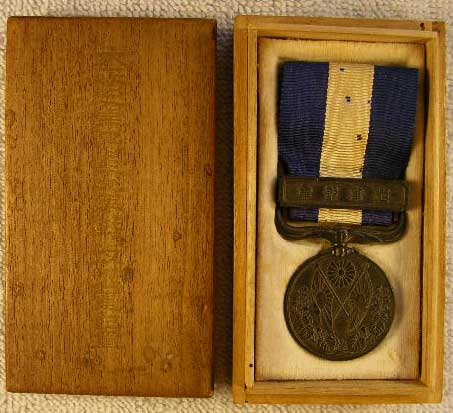
This is the front. I think the little
blue dots in the white part of the ribbon are just flaws since OMJAS says the
ribbons on the early and late medals are identical. Generally the medal looks
very similar to the early type from the front.
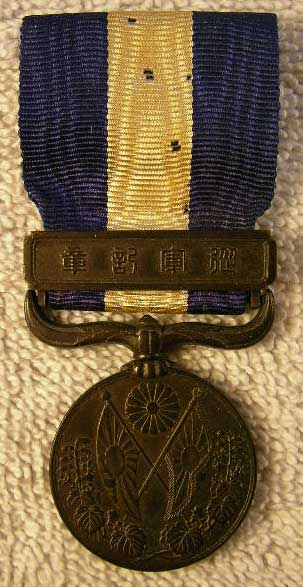
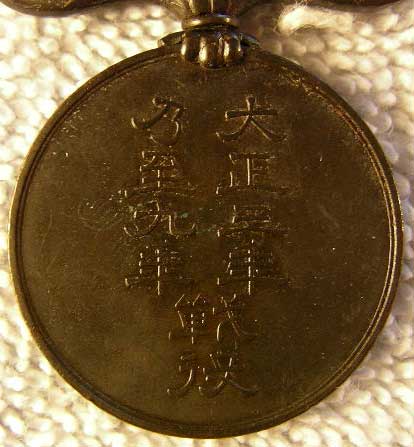
The back obviously has a different inscription.
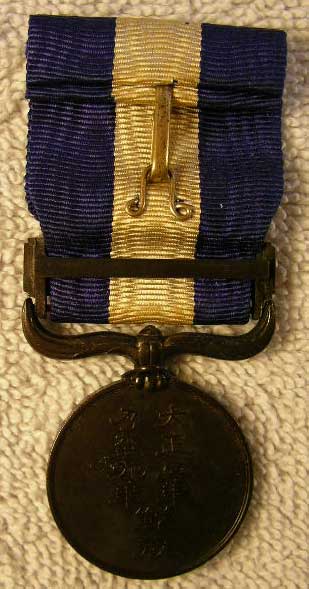
Viewed more closely, there are a few minor
differences between the fronts of the early and late types. The late type has a
larger chrysanthemum and the impression made by the die is shallower. The medal
is 30 mm (1-3/16”) in diameter.
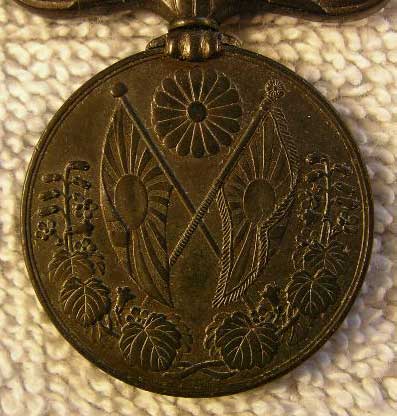
The inscription on the back is tai-sho-san-nen-nai-shi-kyu-nen-sen-eki,
meaning “Campaign from Taisho 3 to 9”.
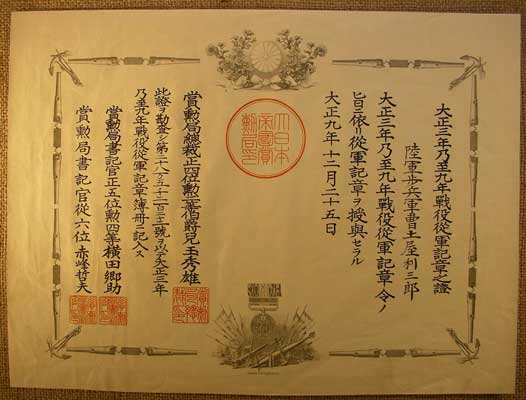
The certificate measures 394mm X
294mm (15-1/2” by 11-19/32”). The right side has the recipient and the date of
the award. The left side has the formalities from the Board of
Decorations. It has no watermarks and
nothing is printed or stamped on the back.
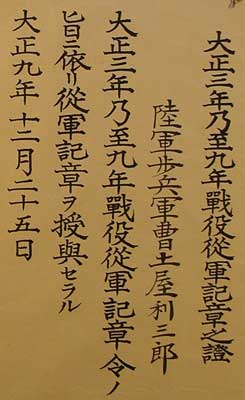
This close-up of the right side has
the most important information.
First
column (far right): Tai-sho-san-nen-nai-shi-kyu-nen-sen-eki-ju-gun-ki-sho-no-sho
Second
column from right: Riku-gun-ho-hei-gun-so-tsuchi-ya-ri-sabu-ro
Third
column from right: Tai-sho-san-nen-nai-shi-kyu-nen-sen-eki-ju-gun-ki-sho-rei-no
Fourth
column from right: mune-ni-yori-ju-gun-ki-sho-o-ju-yo-seraru
Last column
(on left): Tai-sho-kyu-nen-ju-ni-gatsu-ni-ju-go-nichi
This translates roughly as:
“Certificate for Medal for Military Service During the Campaign from Taisho 3
to 9 [1914-1920]. Army Infantry Sergeant Risaburo Tsuchiya [surname is
Tsuchiya] is awarded the Medal for Military Service in accordance with the
regulations regarding the Medal for Military Service During the Campaign from
Taisho 3 to 9. Dated December 25, Taisho 9 [1920].” I bought this certificate
at an antique market in
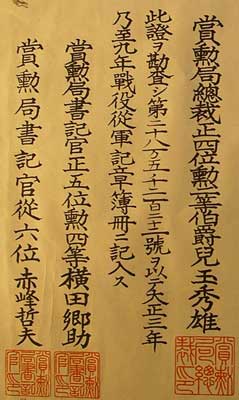
This close-up of the left side has
the formalities from the Board of Decorations (shokunkyoku).
First
column on far right: Sho-kun-kyoku-so-sai-sho-yon-i-kun-ni-to-haku-shaku-ko-dama-hide-o
Second
column from right: kono-sho-o-kan-sa-shi-dai-ni-ju-hachi-man-go-sen-ni-hyaku-ni-ju-ni-go-o-motte-tai-sho-san-nen
Third column
from right: nai-shi-kyu-nen-sen-eki-ju-gun-ki-sho-bo-satsu-ni-ki-nyu-su
Fourth
column from the right: sho-kun-kyoku-sho-ki-kan-sho-go-i-kun-yon-to-yoko-ta-go-suke
Last column
(on the left): sho-kun-kyoku-sho-kan-ju-roku-i-aka-mine-tetsu-o
[last two syllables could also be akio,
sato, or toshio]
With family names underlined, this
translates roughly as: “President of the Board of Decorations Count Hideo Kodama,
Fourth Rank, and Holder of the Second Order of Merit. Having checked this
certificate we have entered it in the Register of Medals for Military Service
During the Campaign from Taisho 3 to 9 [1914-1920] as number 285222. Secretary
of the Board of Decorations Gosuke Yokota, Fifth Rank, Holder of the Fourth
Order of Merit. Secretary of the Board of Decorations Tetsuo [given name could
also be Akio, Sato or Toshio] Akamine, Junior Sixth Rank” The red stamps
at the ends of columns with names and titles repeat the titles of the
individuals whose names appear here, President of the Board of Decorations or
Secretary of the Board of Decorations, as the case may be. I have gone out a
bit on a limb here with my translation. Accompanying the names of senior
figures in pre-war
The big, round red stamp in the middle says Dai nippon teikoku shokunkyokuin. This
means Seal of the Empire of Greater Japan Board of Decorations.
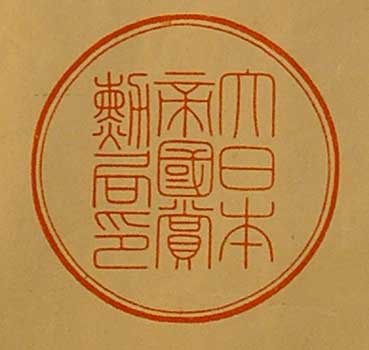
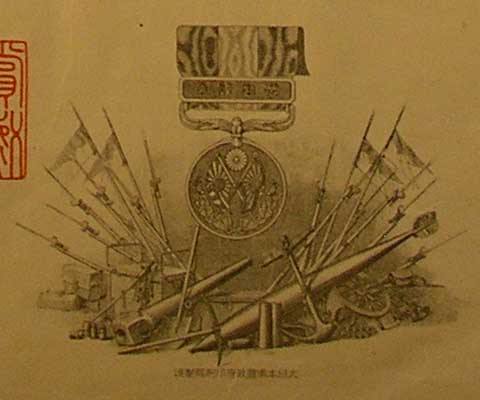
Here is a close-up of the artwork at
the centre-bottom of the certificate. The printing just below it says Dai nippon teikoku seifu insatsu kyoku sei-zo, meaning “Made by the Government
Printing Department of the Empire of Greater Japan”.
If you are interested in finding out
more about Japan’s role in the later part of
World War One, I recommend [I do not yet know of a good book that covers
this period, but I will add the title when I find one].
To return to the
base page on Medals, please click here: Nambu World: Japanese Medals
To return to “Other Japanese Militaria”, please
click here: Nambu
World: Other Japanese Militaria
To return to the home page, please click here: Nambu World: Teri’s WWII Japanese
Handgun Website
Last updated: August
15, 2006. All contents are copyright Teri unless otherwise specified and may
not be used elsewhere in any form without prior permission.