Nambu
World: Russo-Japanese War Medal
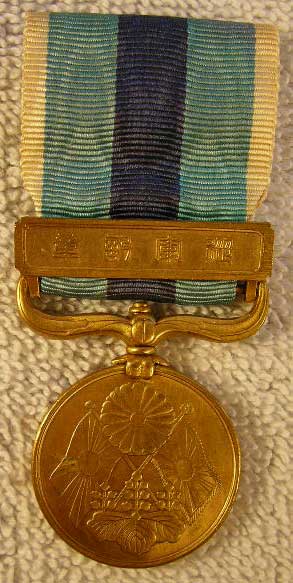
This medal was awarded for service in the war
against
I was surprised by how rough the machining was on this medal. The bar has the four characters ju-gun-ki-sho. Read right to left, they mean “war medal”. The design shows two crossed flags with a chrysanthemum above and paulownia leaves below. The chrysanthemum and paulownia are both symbols of the Imperial family. This medal is covered on page 46 of OMJAS.
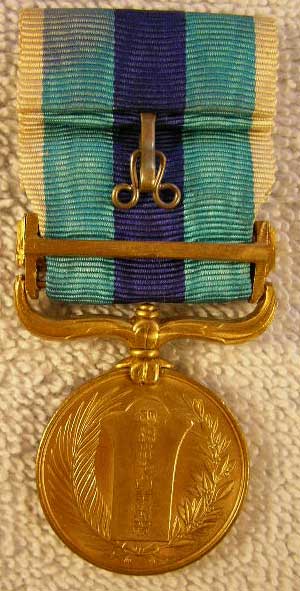
Here is the back. The inscription reads mei-ji-sanju-nana-hachi-nen-sen-eki, top
to bottom. This translates as “Meiji 37-8 campaign”. Meiji 37 to 38 corresponds
to our years 1905-1905. The medal is 30mm (1-3/16”) in diameter. It is made of
a much lighter, more golden coloured metal than any of my other Japanese
service medals.
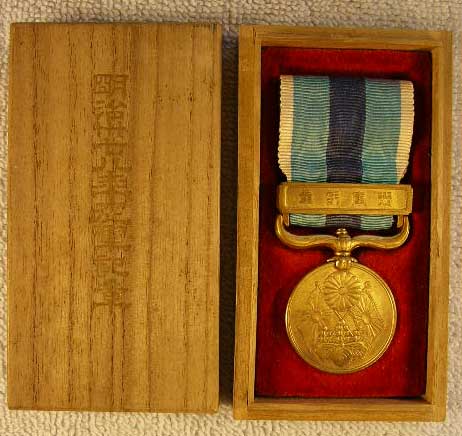
The box is
made of what seems like balsa wood. The characters in gold on the front of the
box say mei-ji-sanju-nana-hachi-nen-ju-gun-ki-sho,
or “Meiji 37-8 war medal.
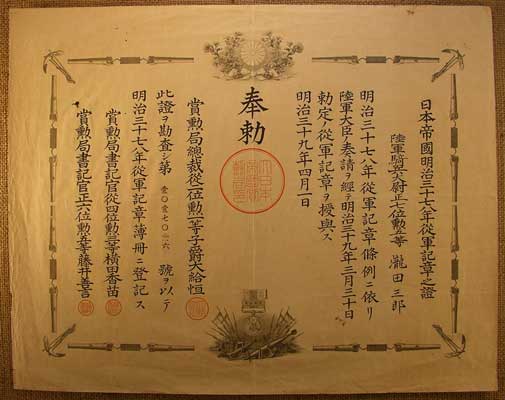
The two
large black characters in the upper centre of the certificate say ho-choku, i.e “service to the Emperor”.
Below that is a big red seal that starts with Dai Nippon Teikoku (Empire of Greater Japan). The certificate is
459mm X 363mm (18-1/16” X 14-5/16”). It does not have any watermarks or
printing or stamps on the back.
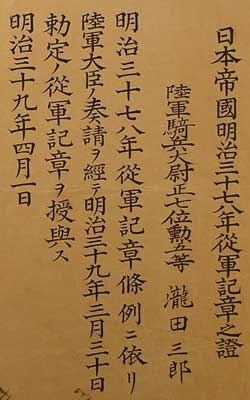
In this close-up of the right side of the certificate the first column on the far right just says Nip-pon tei-koku Mei-ji san-ju-nana-hachi-nen-ju-gun-ki-sho-no-sho, “Japanese Empire Certificate for Medal for Military Service During Meiji 37-8 (1904-05)”. The second column gives the name of the recipient, a man with the surname (family name) Takita (literally “waterfall field”). His given name was Kazuo and he was a captain (tai-i) in the cavalry (kihei). I think the designation after his rank indicates he has received two Orders of Merit, probably the Order of the Rising Sun, 7th class, and the Order of the Golden Kite, 5th class. The remaining text reads:
First column after name (third from right): mei-ji-san-ju-nana-hachi-nen-ju-gun-ki-sho-jo-rei-ni-yori
Second column after name: riku-gun-dai-jin-no-so-sei-o-hete-mei-ji-san-ju-kyu-nen-san-gatsu-san-ju-nichi
Third column after name: choku-tei-no-ju-gun-ki-sho-o-ju-yo-su
Fourth column after name (last on left): mei-ji-san-ju-kyu-nen-shi-gatsu-ichi-nichi
A rough
translation is as follows: “The Minister of War [literally, “of the Army”] has
petitioned the Emperor in accordance with the regulations regarding the Meiji
37-8 military service medal and the military service medal established by
Imperial Edict on March 30, Meiji 39 [1906] is awarded to [the above named
recipient] on April 1, Meiji 39 (1906)”.
Here is a
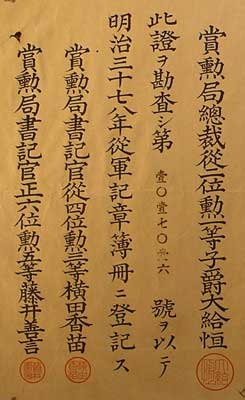
close-up of the left side of the certificate. The first column on the far right
is the name and stamp of the President of the Board of Decorations. He was a shishaku (viscount). His surname has
over a dozen possible pronunciations, most likely Daikyu or Okyu. His given
name also has several possible pronunciations: Tsune, Hisashi, Hitoshi and
Wataru, for example. Since he was a big shot, I may eventually be able to look
him up in a Who’s Who-type directory
in
The second column from the right says: kono-sho-o-kan-sa-shi-dai-ichi-rei-ichi-nana-rei-ichi-roku-go-o-mot-te
The third column from the right (middle column) says: Mei-ji-san-ju-nana-hachi-nen-ju-gun-ki-sho-bo-satsu-ni-to-roku-su.
These two lines translate roughly as follows: “Having checked this certificate, we have recorded it as number 1017016 in the register of Meiji 37-8 military service medals”.
The far
left side has the names of the two secretaries of the Board of Decorations who
made this attestation. The far left column has the name and stamp of Secretary
Zengen Fujii (family name Fujii). The second column from the left has the name
of another Secretary of the Board, Kanae Yokota (family name Yokota). The same
names (Daikyu, Fujii and Yokota) appear on the photo of the certificate shown
on the page on my Boxer Rebellion service medal, which is not surprising since
they were issued only four years apart. The red stamps at the bottom of each
column with a name in it are the name stamps of the official concerned. In
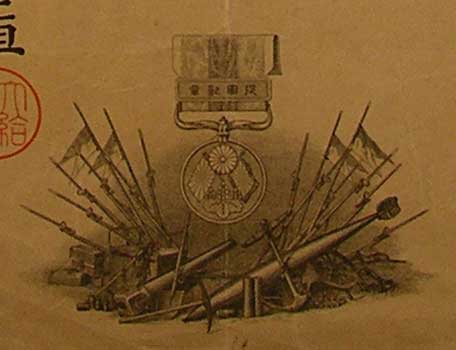
Here is a close-up of the artwork at the centre
bottom of the certificate.
If you would like to find out more
about the Russo-Japanese War, Osprey has two useful publications. The Russo-Japanese War 1904-1905 by
Geoffrey Jukes is part of their Essential Histories series and focuses on the
events. The Russo-Japanese War 1904-05
by A Ivanov and P. Jowett is part of the Men-at-Arms series and deals more with
the equipment and uniforms, etc. in the conflict. Note the very slight
difference in titles (the date is 1904-1905 in one and 1904-05 in the other).
To return
to the base page on Medals, please click here: Nambu
World: Japanese Medals
To return
to “Other Japanese Militaria”, please click here: Nambu World: Other
Japanese Militaria
To return
to the home page, please click here: Nambu World: Teri’s WWII Japanese
Handgun Website
Last updated: July 21, 2006. All contents are
copyright Teri unless otherwise specified and may not be used elsewhere in any
form without prior permission.