
Nambu World:
This is the cover of the
January, 1945 edition of The Ranger, the monthly magazine of the
PCMR. The PCMR was a militia force formed in
The
force was formed on March 14, 1942. At first it was called the Coast Defense
Reserve Militia, but the name was soon changed to the better known PCMR. Over
one hundred companies were formed across
One
of the two pieces of the original “uniform” of the force, the cap badge had a
totem pole-like representation of a mythical thunderbird at the top and a maple leaf in the centre superimposed on a
crossed rifle and double-bladed axe. The motto vigilans at the bottom means watchful or alert in Latin. The badge
is about 40 mm (1-1/2”) high and 43mm (1-3/4”) wide. It is made of a
non-magnetic material that seems to be copper or a copper alloy.

Here
is the back of the badge showing the tangs that were used to attach it to one’s
cap. You can also see three sets of markings: “PMP Ltd.” in the lower left; a
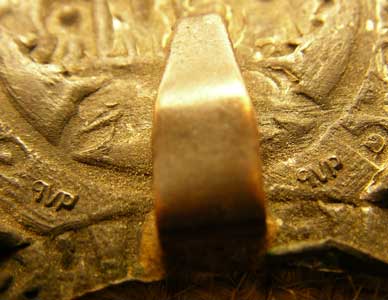
stylized PMP logo in the centre, repeated on either side of the lower tang; and
“
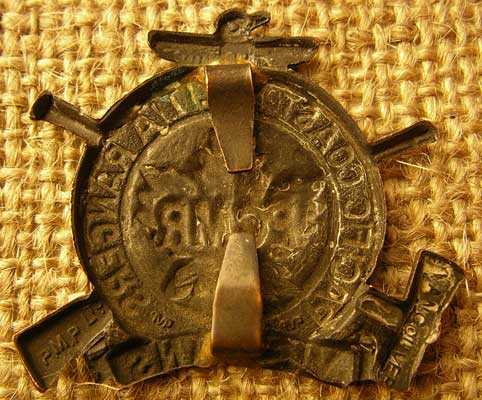
PMP Ltd. was the name of the firm
that made the badges. I have been told they are still in business.

On either side of the lower tang is
the stylized company logo with the first P reversed.
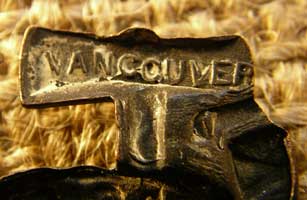
This is the location of production
marking found on the lower right of the reverse of the badge.
PCMR Armband:
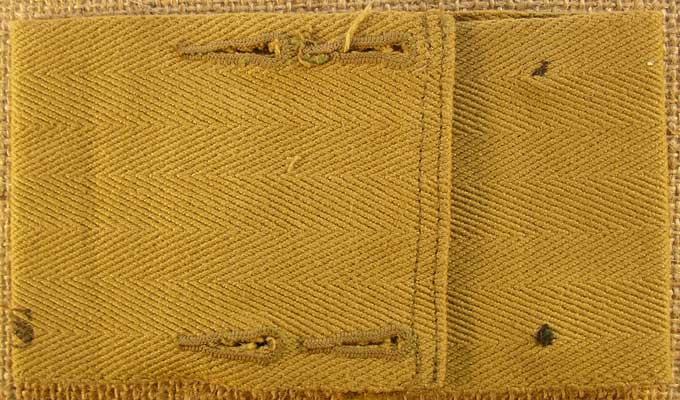
The second component of
the original “uniform” was an armband. I got this one at a gun show in
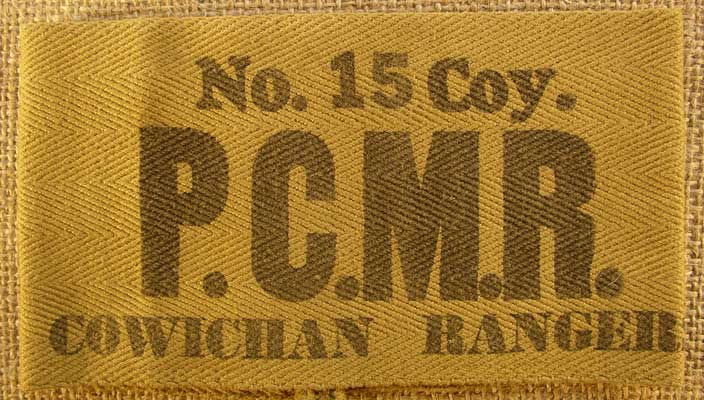
This shot shows the back.
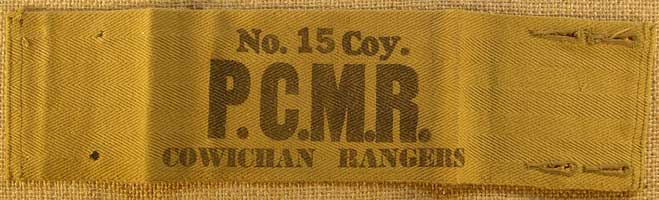
Here it is opened up so you can see
the whole thing. It is about 92mm (3-5/8”) wide and 360mm (14-1/8”) wide.
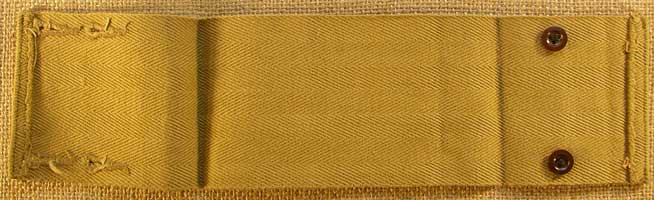
Rear view, opened up.
The Ranger Magazine:
The Ranger magazine was issued from September,
1942 until October, 1945. I have only one issue, January, 1945, which I bought
in the early 1990s because the cover photo showed a Sten gun. At that time I
did not even know what the PCMR was, nor had my interest in the Pacific War
begun to blossom. This issue is 228mm (9”) wide and 296mm (11-3/4”) tall. It
had sixteen pages including the covers and was full of articles on
understanding the enemy, small group tactics, woodsmanship, marksmanship and
the war in general. The description of the cover photo begins: “Appropriately
enough the man on this month’s cover is an Indian. No one is more fitted to
take part in the defense of this province than the native son, for his heritage
as a British Columbian runs far back into the beginning of time. We are glad to
have his native skill and woodcraft working against the common enemy.” Since
discrimination against aboriginal people was rampant at the time (and is still
far from unknown), this was clearly intended to signal that such feelings
should be put aside, at least for the duration of the war. I have read each
company was issued Sten guns for the NCOs and officers.
The
first feature article in this issue covered Japanese infantry weapons and was
based on a

As
noted above, the standard weapons was a Winchester Model 1894 .30-30 lever
action rifle. The article below is from page 7 and commemorates the 50th
anniversary of that venerable weapon. The article ends: ‘…if it killed a bear
cleanly for you in the piping times of peace you can be quite sure that it will
drill a Jap or any other unwholesome vermin who make the mistake of cluttering
up our coast.” The use of crude racist language and stereotyping was common and
reflected widespread sentiments of the time. I have seen another Ranger article
in another issue about how to differentiate between a Chinese and a Japanese. It
contained nothing but crude and inaccurate stereotypes, but did serve the
purpose of telling the members that not all non-whites were the enemy, which
was no doubt also part of the motivation for the cover photo shown above.

When the PCMR was disbanded the men were allowed to buy their rifles from the government for $5. An example of such a rifle and its matching receipt is shown below.
As noted in the above Ranger article, the Winchester Model 1894 Carbine in .30-30 calibre was the standard weapon of the PCMR, although they also issued some Marlins and a few Winchester lever actions of other models. Through the generous assistance of a dedicated PCMR collector, in 2008 I was able to add one of these rifles to my collection, along with the receipt showing its provenance. In principle they are the basic Winchester model, although with a rather makeshift looking front sling swivel to accommodate the standard canvas Lee-Enfield sling used by the Canadian military. They were marked with the Canadian military marking called the "C-broad arrow" by collectors. Here is the right side.
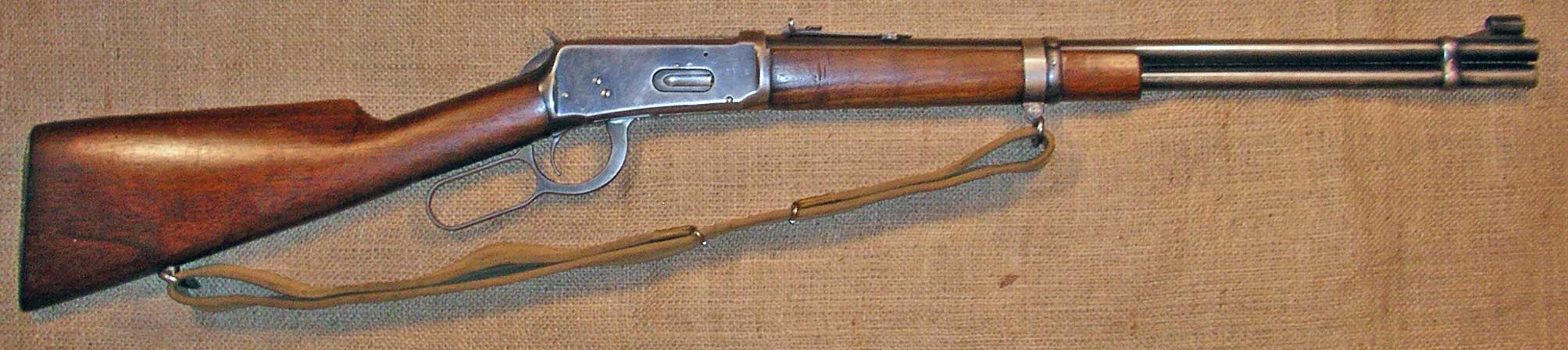
The left side.

Close-up of the right side of the action.

And the left side. Note the position of the marking in the lower front corner of the action.
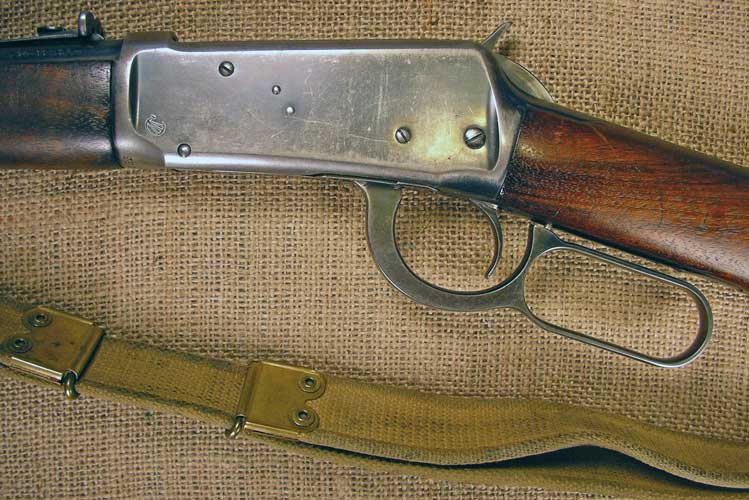
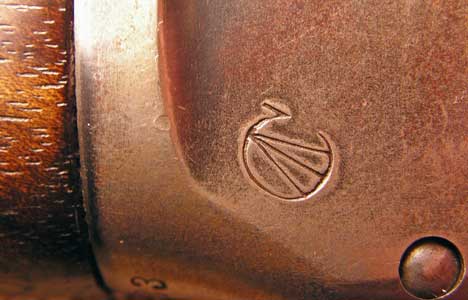
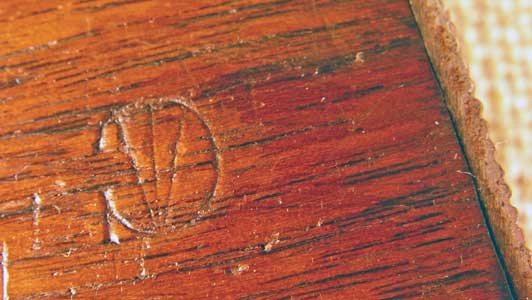
Here is a close-up of the "C-broad arrow". This mark is applied three times: here on the receiver, on the butt stock and on the forestock.
Here is the one on the butt stock (upside down).
The one on the forestock is quite faint, perhaps from wear.

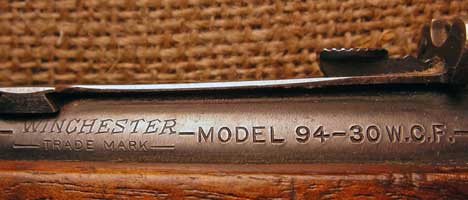
I believe the rest of the markings are standard. Here is the left side of the barrel just in front of the sight.

Just a little further back on the same side. .30W.C.F. (Winchester Centre-Fire) is the old name for .30-30.
The serial number is under the front of the receiver. I believe all the PCMR model 94s are from this approximate serial range.
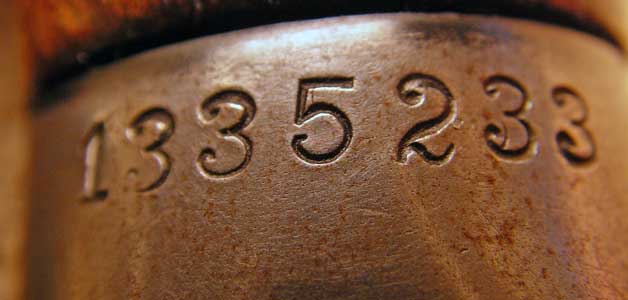
Here is the rear sight. You can also see the two Winchester proof marks (WP in an oval cartouche).
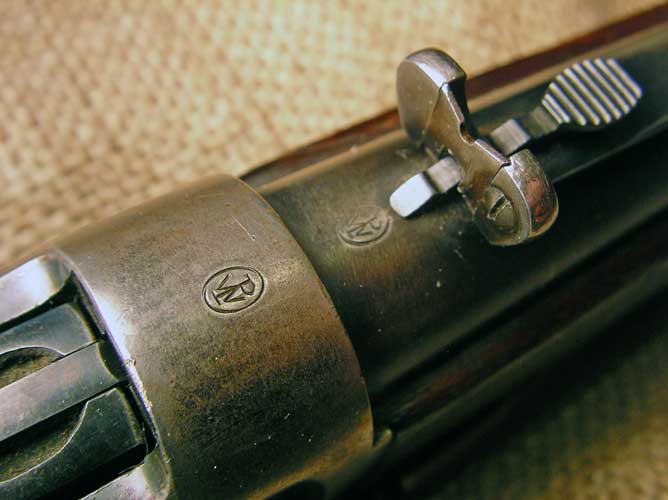
The rear tang.

A close-up of that crude swivel I mentioned. I have been told that although the carbines themselves were issued free of charge, the militiamen had to pay for this accessory, which was necessary to attach the standard Canadian military sling.

At the end of the war the militiamen had the option of buying their rifles for $5. Here is the receipt for this one.

PCMR links:
The best general information on the
PCMR is at this link: PCMR
Another good one is: Pacific
Coast Militia Rangers - www.canadiansoldiers.com
One that focuses on the use of
the Winchester Model 94 .30-30 rifle is: PCMR, Pacific Coast
Militia Rangers &The BC Rangers
To return to the Nambu World:
To return to the Nambu World home page, please click here: Nambu World: Teri’s WWII Japanese
Handgun Website
Last updated:
June 27, 2008. All contents are copyright Teri
unless otherwise specified and may not be used elsewhere in any form without
prior permission.